
SDC at a glance
- What it is:
- Controlled cold is applied to the dorsal nerve branches on the top of the penis, temporarily reducing their sensory conduction.
- Who it is for:
- Men with lifelong (primary) premature ejaculation who have not benefited enough from medication and behavioural therapy, or who prefer not to use them.
- Duration:
- About 20 minutes, under local anaesthesia.
- Incision / stitches:
- None. The procedure is performed through a needle.
- Discharge:
- Same day.
- Developed by:
- Dr. Yasar Basaga. The technique was described in the medical literature in his 2026 article in The Journal of Sexual Medicine.
- Published result:
- In our 108-patient study, ejaculation time increased roughly fourfold at 12 months, from 54 to 231 seconds on average (Basaga et al., J Sex Med, 2026).
- Good to know:
- The effect is reversible. A large proportion of patients need a second session, and about 1 in 10 men do not respond adequately.
Selective dorsal cryoablation, also called selective dorsal cryoneurolysis (SDC), is a minimally invasive treatment for lifelong premature ejaculation developed by Dr. Yasar Basaga and first described under this name, with a standardised protocol, in The Journal of Sexual Medicine (2026).
What Is Selective Dorsal Cryoablation (SDC)?
Selective dorsal cryoablation, known in the medical literature as selective dorsal cryoneurolysis (SDC), is a minimally invasive procedure in which the dorsal nerve branches that carry sensory signals from the penis are frozen with a special cryoprobe and temporarily “quietened”.
The nerve is not cut. Freezing causes a temporary loss of conduction in the nerve fibres (axonotmesis), while the connective tissue sheath around the nerve remains intact. Thanks to this sheath, the nerve can regenerate in an orderly way over time. This is the key feature that distinguishes the method from selective dorsal neurectomy (SDN), which cuts the nerve permanently: SDC is potentially reversible.

The Developer of the Technique: Dr. Yasar Basaga
The selective dorsal cryoablation technique was developed by Dr. Yasar Basaga. Its procedural protocol, patient selection criteria, follow-up method with objective sensitivity measurement and 12-month results were described in the medical literature in the article by Basaga and colleagues published in 2026 in the international peer-reviewed Journal of Sexual Medicine. This is the first article in the literature to describe selective dorsal cryoneurolysis (SDC) by this name and with a standardised protocol 1.
How the technique came about:
Surgical cutting of the dorsal nerve branches (selective dorsal neurectomy) has been used for many years to reduce penile sensitivity in premature ejaculation 7, 8. Although this method can prolong ejaculation time, it is not recommended by international guidelines because of the risk of permanent sensory loss and variable results 3, 4, 5. In 2013, a small study tested CT-guided freezing of the dorsal penile nerve, but this earlier approach did not become widely adopted 9.
Starting from the idea of switching the nerve off selectively and reversibly, without cutting it, Dr. Yasar Basaga developed the selective dorsal cryoablation technique: an outpatient procedure under local anaesthesia, taking about 20 minutes, repeatable, and followed up with objective measurements (biothesiometry). The technique was introduced to the international literature with 12-month follow-up data from 108 patients 1.
The Role of Penile Hypersensitivity in Premature Ejaculation
Lifelong premature ejaculation means that, since the first sexual experience, ejaculation usually occurs within about 1 minute. It affects roughly 3–5% of sexually active men. Its causes are multifactorial. Alongside central factors related to the brain’s serotonin system, hypersensitivity of the glans penis plays an important role in many patients. Research shows that men with lifelong premature ejaculation have significantly lower penile sensory thresholds than healthy men.
SDC targets this peripheral (penile) component. When sensory input from the penis is reduced, the threshold needed to trigger the ejaculatory reflex rises and ejaculation time is prolonged.
An important note: SDC does not change the psychological, relational or central (brain-related) components of premature ejaculation. It is therefore best considered as part of a holistic approach, combined with sex therapy and counselling when needed.
Who Is a Candidate for Selective Dorsal Cryoablation?
In our published study, patients treated with SDC were selected according to the following criteria:
- A diagnosis of lifelong premature ejaculation according to the International Society for Sexual Medicine (ISSM) criteria (ejaculation within about 1 minute in more than 70% of intercourse since the first experience)
- Normal erectile function (IIEF-5 score > 21)
- PEDT (Premature Ejaculation Diagnostic Tool) score > 11
- A regular partner for at least 6 months
- Insufficient benefit from medication (SSRIs, dapoxetine, clomipramine, topical anaesthetic creams, PDE5 inhibitors) and behavioural therapy, or unwillingness to use these treatments
SDC may not be suitable: It was not performed in men with inflammation of the glans (balanitis), bleeding disorders or those taking psychiatric medication. Acquired (secondary) and variable or subjective premature ejaculation were not included in the study. The underlying cause should be investigated first; SDC may be considered on an individual basis after clinical assessment.
Pre-Treatment Assessment
Before deciding on treatment, the following assessments are performed:
- Detailed history and examination: The type and duration of premature ejaculation and previously tried treatments are evaluated.
- Questionnaires: Severity is measured with the PEDT and the Premature Ejaculation Profile (PEP). Erectile function is checked with the IIEF-5.
- Penile sensitivity testing (biothesiometry): Vibration perception thresholds are measured in volts at the penile base, frenulum and right and left dorsal regions. This documents sensitivity objectively and allows follow-up after treatment.
- IELT (intravaginal ejaculatory latency time): Measured with a stopwatch to record a baseline value.
At our clinic, this assessment is performed with the Sensiometer and PENMED devices. See the PENMED premature ejaculation diagnostic device.
How Is SDC Performed? (Step by Step)
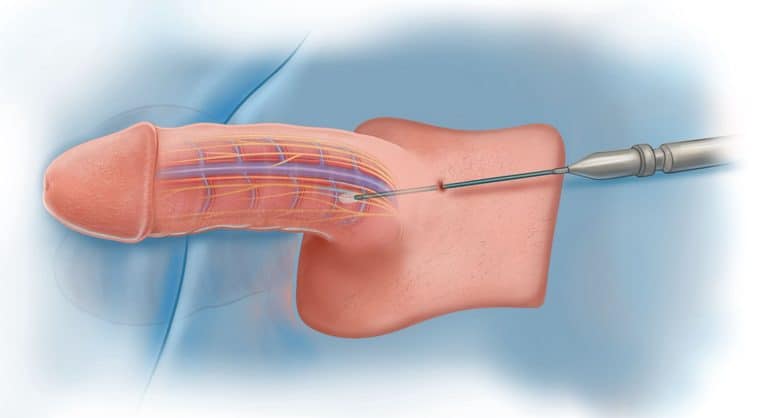
The standard technique described in our article is as follows:
- Local anaesthesia: A mixture of local anaesthetic and a long-acting agent is injected about 2 cm above the base of the penis, followed by a waiting period of about 20 minutes.
- Guide needle: The penile skin is lifted by hand and protected. A thin guide needle is advanced through the pubic fat tissue, avoiding blood vessels.
- Placing the cryoprobe: The cryoprobe is guided through this channel to the dorsal surface of the penis and passes through Buck's fascia to reach the nerve bundles.
- Targeting: Four nerve bundles are targeted on either side of the dorsal vein: right and left median, and right and left lateral.
- Freezing: Each site receives two 2-minute freeze cycles separated by a 1-minute thaw. An ice ball of about −78 °C forms at the probe tip.
- Skin protection: Throughout the procedure, the skin is kept lifted so that it does not touch the probe.
- Total time: About 20 minutes. No incision or stitches are needed.
- After the procedure: Oral medication (dexamethasone) is given for 3 days to reduce pain and prevent nerve-end nodules (neuroma).
The closer to the base of the penis the nerve is frozen, the longer the effect lasts. For this reason, the procedure is performed in the penopubic region, where the penis meets the lower abdomen.
Results of Our Published Study (108 Patients, 12 Months)
The results of 108 men with lifelong premature ejaculation treated with SDC between January 2024 and January 2025 were published in The Journal of Sexual Medicine (September 2026). The mean age was 40.4 years (range 20–64). All patients were followed for 12 months, with no loss to follow-up. This is the largest patient series on SDC published to date.
Ejaculation Time (IELT)
| Time point | Mean IELT (s)* | Median (s) | Increase from baseline |
|---|---|---|---|
| Baseline | 54 | 60 | — |
| Month 1 | 139 | 180 | ~2.6× |
| Month 3 | 210 | 240 | ~3.9× |
| Month 6 | 244 | 240 | ~4.5× |
| Month 9 | 231 | 240 | ~4.2× |
| Month 12 | 231 | 240 | ~4.3× |
*Geometric mean. The difference from baseline was statistically significant at all time points (p < 0.001).
Ejaculation time began to increase from the first month, was largely established by month 3 and was maintained up to month 12.
Patient-Reported Outcomes and Objective Measurements
| Measure | Baseline | Month 12 | What it means |
|---|---|---|---|
| PEDT score (lower = better) | 14.3 | 8.4 | Fell below the diagnostic threshold of 11 |
| PEP total score (higher = better) | 6.0 | 11.6 | Improvement in control, satisfaction and distress |
| Penile vibration threshold (V) | ~4.5 | ~10.7 | Objective reduction in sensitivity |
Penile vibration thresholds more than doubled at all four measurement sites. This objectively shows that the clinical improvement was linked to a genuine reduction in sensory input from the penis.
Results were similar in patients under and over 50 years of age. At month 12, IELT was 233 s versus 227 s, and the difference was not significant.
Interpreting the Results Correctly
- Repeat sessions: 75.9% of patients received a second session and 20.4% a third. Repeat sessions were performed with the same technique in patients whose effect faded or was insufficient. The results above therefore reflect a treatment strategy with repeat sessions when needed, not a single procedure.
- Non-responders: Premature ejaculation persisted in 10.2% of patients (11 men). In 8 of them, symptoms continued even though penile sensitivity had decreased. This shows that premature ejaculation is not caused by penile sensitivity alone.
- Study limitations: The study was retrospective and had no control group. Partners were not assessed. All procedures were performed by a single experienced physician.
Safety: Side Effects and Risks
In the 108-patient series over 12 months of follow-up:
- No patient developed erectile dysfunction, loss of orgasm (anorgasmia), permanent numbness, skin damage or necrosis, haematoma, infection or painful intercourse.
- 8 patients (7.4%) experienced mild, local discomfort related to the procedure. All of these complaints resolved spontaneously without additional treatment.
As with any medical procedure, SDC carries theoretical risks: temporary bruising or swelling at the treatment site, temporary changes in sensation and, rarely, infection or an allergic reaction to medication. Because nerve branching varies from person to person, targeting may be more difficult in some patients and the effect may be weaker. This is why it is important that the procedure is performed by a physician experienced in this field.
Recovery After the Procedure
- Discharge: Same day. Daily and social activities can be resumed the same day.
- Medication: Oral medication is taken for 3 days.
- Hygiene: Keeping the treatment area clean and dry is recommended.
- Sexual activity: Sexual activity can be resumed on the same day.
- Onset of effect: In our study, a clear increase in ejaculation time was seen at month 1 and was largely established by month 3.
- Follow-up visits: IELT, questionnaires and biothesiometry are repeated at months 3, 6, 9 and 12.
How Long Does the Effect Last? Is SDC Permanent?
Because the nerve is not cut in SDC, the effect is reversible. As the nerve fibres regenerate, some sensitivity may return and premature ejaculation may recur. In our study, the effect was maintained for 12 months, but most patients received a second session to achieve these results. Further studies are needed for data beyond 12 months.
Reversibility is also an advantage. The procedure can be safely repeated when needed and the effect can be adjusted to the patient’s needs. This is not possible with methods that cut the nerve permanently.
SDC Compared With Other Premature Ejaculation Treatments
| Feature | Medication | Glans filler | SDC (cryoablation) | SDN (neurectomy) |
|---|---|---|---|---|
| Method | Daily or on-demand pills | Injection | Local anaesthesia, needle | Surgical incision |
| Effect on nerve | None | None | Temporary conduction loss | Permanent cut |
| Reversible | Yes | Partly | Yes | No |
| Repeat needed | Ongoing use | May be needed | May be needed | Usually one-off |
| Guideline status | Standard treatment | Not standard | Investigational | Not recommended |
SDC sits as an intermediate option between medication and permanent nerve cutting (neurectomy). For other options: Glans Penis Filler · Selective Dorsal Neurectomy · What Is Premature Ejaculation? · Premature Ejaculation Treatments
Scientific Status: What You Should Know
Selective dorsal cryoneurolysis is a new method with promising results. However, it is not currently included as a standard treatment in international urology guidelines (EAU, AUA/SMSNA, ISSM) and is considered investigational. The results need to be confirmed by randomised controlled trials. We believe it is important to share this openly so that our patients can make an informed decision.
Teaching the Technique Worldwide: International Training
Dr. Yasar Basaga teaches the selective dorsal cryoablation technique he developed to urologists and andrologists from Turkey and around the world through hands-on training. Participants have included physicians who are among the leading names in their field internationally.
Training covers patient selection, dorsal nerve anatomy, step-by-step performance of the procedure, objective measurement with biothesiometry, the follow-up protocol and planning of repeat sessions.
Some of the physicians who have received training:
| Physician | Country | Training date |
|---|---|---|
| Dr. Sam Ward | Belgium | April 2026 |
| Dr. Taras Hladun | Poland | February 2026 |
| Dr. Jose Alfredo Ruiz | Mexico | May 2026 |
| Dr. Ismailov Ismat Yasirovic | Russia | December 2025 |
| Dr. Muhammad Hamdan | Jordan | July 2026 |
| Dr. Anas M. Hasan | Iraq | June 2026 |
| Prof. Dr. Gabriele Antonini | Italy | October 2025 |
Training in Pictures


Why Dr. Yasar Basaga?
- He is the physician who developed the selective dorsal cryoablation technique.
- He is the first author of the article that describes the technique in the literature, including 12-month results in 108 patients (The Journal of Sexual Medicine, 2026) 1.
- He teaches the technique to urologists and andrologists from Turkey and abroad through hands-on training.
- He applies a standardised protocol with patient selection, objective sensitivity measurement (biothesiometry) and structured 12-month follow-up.
For International Patients
Many of our SDC patients travel to Istanbul from abroad. To make the process easier:
- Online pre-assessment: You can share your history and previous treatments with us before travelling, so that suitability can be assessed in advance.
- Length of stay: The procedure takes about 20 minutes and you are discharged the same day.
- Follow-up: Follow-up at months 3, 6, 9 and 12 can be arranged at our clinic or remotely, depending on your situation.
- Language: Consultations are available in English.
- Transfer and accommodation: Support with airport transfers and hotel arrangements is available.
To ask about suitability or plan your visit, please contact us.
Cost of Selective Dorsal Cryoablation
The cost of SDC depends on the tests performed during the initial assessment, the treatment plan and the need for repeat sessions. Clear information is provided after the measurements at your first consultation. Possible additional sessions are discussed in advance during planning.
References
Article describing the technique
- Basaga Y, Albayrak AT, Sertkaya Z, Serefoglu EC. Clinical outcomes of selective dorsal cryoneurolysis in patients with lifelong premature ejaculation: a retrospective cohort of 108 men. J Sex Med. 2026;23(10):qdag284. https://doi.org/10.1093/jsxmed/qdag284
Definition and international guidelines
- Serefoglu EC, McMahon CG, Waldinger MD, et al. An evidence-based unified definition of lifelong and acquired premature ejaculation: report of the second ISSM ad hoc committee. Sex Med. 2014;2(2):41–59. https://doi.org/10.1002/sm2.27
- Salonia A, Bettocchi C, Boeri L, et al. European Association of Urology guidelines on sexual and reproductive health – 2021 update: male sexual dysfunction. Eur Urol. 2021;80(3):333–357. https://doi.org/10.1016/j.eururo.2021.06.007
- Shindel AW, Althof SE, Carrier S, et al. Disorders of ejaculation: an AUA/SMSNA guideline. J Urol. 2022;207(3):504–512. https://doi.org/10.1097/JU.0000000000002392
- Althof SE, McMahon CG, Waldinger MD, et al. An update of the International Society of Sexual Medicine's guidelines for the diagnosis and treatment of premature ejaculation (PE). J Sex Med. 2014;11(6):1392–1422. https://doi.org/10.1111/jsm.12504
Penile sensitivity and earlier approaches targeting the dorsal nerve
- Guo L, Liu Y, Wang X, et al. Significance of penile hypersensitivity in premature ejaculation. Sci Rep. 2017;7(1):10441. https://doi.org/10.1038/s41598-017-09155-8
- Zhang GX, Yu LP, Bai WJ, Wang XF. Selective resection of dorsal nerves of penis for premature ejaculation. Int J Androl. 2012;35(6):873–879. https://doi.org/10.1111/j.1365-2605.2012.01296.x
- Liu Q, Li S, Zhang Y, et al. Anatomic basis and clinical effect of selective dorsal neurectomy for patients with lifelong premature ejaculation: a randomized controlled trial. J Sex Med. 2019;16(4):522–530. https://doi.org/10.1016/j.jsxm.2019.01.319
- David Prologo J, Snyder LL, Cherullo E, et al. Percutaneous CT-guided cryoablation of the dorsal penile nerve for treatment of symptomatic premature ejaculation. J Vasc Interv Radiol. 2013;24(2):214–219. https://doi.org/10.1016/j.jvir.2012.09.015
- Culha MG, Erkoc M, Baran C, Ozcan L. Clinical efficacy and safety of selective dorsal neurectomy/cryoablation for treatment of premature ejaculation: systematic review and meta-analysis. J Sex Med. 2025;22(8):1383–1389. https://doi.org/10.1093/jsxmed/qdaf140
Effect of cryoneurolysis on the nerve (reversibility)
- Ilfeld BM, Finneran JJ. Cryoneurolysis and percutaneous peripheral nerve stimulation to treat acute pain. Anesthesiology. 2020;133(5):1127–1149. https://doi.org/10.1097/ALN.0000000000003532
- Hsu M, Stevenson FF. Wallerian degeneration and recovery of motor nerves after multiple focused cold therapies. Muscle Nerve. 2015;51(2):268–275. https://doi.org/10.1002/mus.24306
Measurement tools
- Symonds T, Perelman MA, Althof S, et al. Development and validation of a premature ejaculation diagnostic tool. Eur Urol. 2007;52(2):565–573. https://doi.org/10.1016/j.eururo.2007.01.028
- Althof S, Rosen R, Symonds T, et al. Development and validation of a new questionnaire to assess sexual satisfaction, control, and distress associated with premature ejaculation. J Sex Med. 2006;3(3):465–475. https://doi.org/10.1111/j.1743-6109.2006.00239.x
Medically reviewed by: Yasar Basaga, MD, PhD, FEBU, Urologist and Andrologist · Last updated: This page is for information only and does not replace a medical consultation.