

Table of Contents
- What Are P-Shot and PRP?
- Is P-Shot a Miracle or Just Hype?
- What Does P-Shot Target in Penile Tissue?
- How Is PRP Prepared?
- What Problems Can Occur with Standard PRP Kits?
- How Are Gel Separator PRP Kits Different?
- What Determines the Outcome of P-Shot Treatment?
- Conclusion: The Value of P-Shot Depends on Patient Selection and Preparation Quality
- Frequently Asked Questions (FAQ)
P-Shot, also known as the Priapus Shot, is essentially a PRP application. PRP stands for platelet-rich plasma. It is one of the applications widely used and attracting interest in Türkiye, Europe, and the United States.
As interest in non-surgical and regenerative methods has grown, P-Shot has been researched more extensively, particularly in relation to erectile dysfunction. However, increased interest does not mean that the treatment will produce the same result in every patient.
There is no one-word answer to whether P-Shot is effective. It can produce encouraging results in the right patient and as part of the right treatment combination. In patients who are unsuitable for the procedure or whose condition is advanced, however, it may be ineffective and may even cause harm.
What Are P-Shot and PRP?
P-Shot is based on PRP
P-Shot is not a separate biological product. It is based on platelet-rich plasma obtained from the patient’s blood. The platelets and growth factors in this plasma are intended to accelerate the healing process in penile tissue and contribute to tissue repair.
Why is interest in regenerative treatments increasing?
Interest in non-surgical treatments among people experiencing erectile dysfunction continues to grow. While this has led to more research and discussion about P-Shot, it also creates a risk that the method may be used incorrectly.
Is P-Shot a Miracle or Just Hype?
Why can the answer be both yes and no?
The value of P-Shot depends less on the name of the procedure than on which patient receives it and under what conditions. Good results may be achieved when it is used in the right patient and as part of an appropriate combination of treatments. Applying the same protocol to every patient is not appropriate.
Not every patient is suitable for P-Shot
P-Shot may be completely ineffective in people with advanced disease or in those who are not suitable candidates for the treatment. An inappropriate application may do more than fail to provide benefit; it may also lead to harmful outcomes. Patient selection is therefore one of the main factors determining the result.
What Does P-Shot Target in Penile Tissue?
The purpose of growth factors
The primary purpose of the plasma and growth factors in PRP is to accelerate healing in penile tissue and contribute to the regeneration process. The aim is not simply to perform an injection, but to support the tissue’s capacity to heal.
Why nerve, muscle, and capillary structures matter
Penile tissue contains nerves, spongy muscle tissue, and a dense network of capillaries. The quality of the spongy muscle tissue and the density of the blood vessels are important for achieving an erection. P-Shot is regarded as a method that may contribute to improving the organization and quality of these structures.
How Is PRP Prepared?
Blood collection and centrifugation
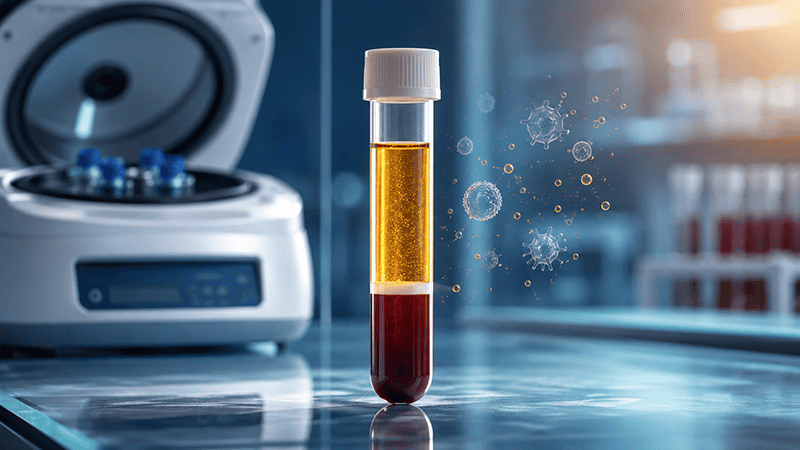
To prepare PRP, a tube of blood is collected and placed in a centrifuge that spins at high speed. After this process, the different components of the blood separate according to their density, producing the final material to be used for injection.
The layers formed after centrifugation
Red blood cells settle at the bottom of the tube. Immediately above them is a thin and valuable layer known as the buffy coat, which contains platelet-rich cells and plasma. The upper section contains a yellowish serum portion that is poor in platelets and contains fewer white blood cells.
The most valuable part of PRP is the buffy coat layer between the red blood cells and the serum above. The quality of the application is closely related to how accurately and completely this thin layer is collected.
What Problems Can Occur with Standard PRP Kits?
With standard kits, the layers may not always separate clearly. When the buffy coat is collected, the collection may extend into the red blood cell layer, or the entire valuable layer may not be obtained.
Even when centrifugation has separated the components, this can result in an incomplete transfer of platelets and growth factors to the final product. It is therefore important not only to prepare PRP, but also to collect the correct layer efficiently.
How Are Gel Separator PRP Kits Different?
Separating red blood cells from serum
In gel separator kits, the gel creates a clearer boundary between the red blood cells and the serum above. This separation allows the platelet-rich buffy coat layer to be collected in a more controlled manner.
Reducing the loss of platelets and growth factors
By separating the valuable layer more clearly, the aim is to collect the platelets and growth factors without loss. The goal is therefore not simply to perform an injection called PRP, but to obtain a treatment material of high preparation quality.
What Determines the Outcome of P-Shot Treatment?
The main points that determine the treatment outcome in this approach are:
- Selecting the patient appropriately for P-Shot
- Considering the severity of erectile dysfunction and the underlying condition
- Planning the treatment as part of an appropriate combination
- The separation quality of the kit used to prepare PRP
- Collecting the buffy coat without losing platelets and growth factors
Highlighting only the name P-Shot without considering these factors together does not mean that the expected treatment outcome will be achieved.
Conclusion: The Value of P-Shot Depends on Patient Selection and Preparation Quality
P-Shot is neither a method that produces miraculous results in every patient nor a completely ineffective procedure. In the right person and within an appropriate treatment plan, it may support the healing of penile tissue; in unsuitable patients, it may not produce a result.
The way PRP is prepared is as important as patient selection in determining treatment quality. Correct separation of the platelet-rich buffy coat and collection of the platelets and growth factors without loss are fundamental parts of the procedure.


